Croatian wedding traditions and how they look on film
A Croatian wedding is a long day full of customs that every family keeps a little differently. If you're marrying into a Croatian family or celebrating with Croatian guests, here's what usually happens and what it means for your wedding film.
 Damir Pišćetek, wedding videographer ·
In short: the day often starts with the groom's party coming to pick up the bride, led by the wedding flag, the barjak. The kum and kuma are the witnesses and the couple's right hands. After the ceremony comes a long receiving line, with every guest congratulating the couple, and the party goes late into the night, with the cake around midnight. For the film, that usually means a long day of coverage.
Picking up the bride
On the morning of the wedding the groom's family and friends - the svatovi, the wedding party - gather at the groom's house. From there they set off together, often in a convoy of decorated cars with horns honking, to the bride's house. The bride's family doesn't give her away easily: in many places the groom has to "buy" the bride, with some bargaining and plenty of jokes, and sometimes a "fake bride" appears first. On film these are some of the liveliest scenes of the day - laughter, music and moments nobody could plan.
The barjak, the wedding flag
The barjak is a traditional wedding flag, usually the Croatian flag decorated with ribbons, carried by the barjaktar at the head of the wedding party. It leads the svatovi from the house to the church and on to the celebration. The flag and the procession behind it make one of the most recognisable images of a Croatian wedding.

Kum and kuma
The kum and kuma are the witnesses at the ceremony, but their role goes far beyond a signature. They stand by the couple all day, help with the organisation and often give a toast. They're among the people who appear most often in the film, so it helps if I know who they are before the wedding.
Rosemary for the guests
At many weddings guests get a sprig of rosemary tied with a ribbon, pinned to their clothes as a sign that they're part of the wedding. It's a small detail, but it shows up in many shots and gives the film a recognisable touch.
The ceremony and the congratulations
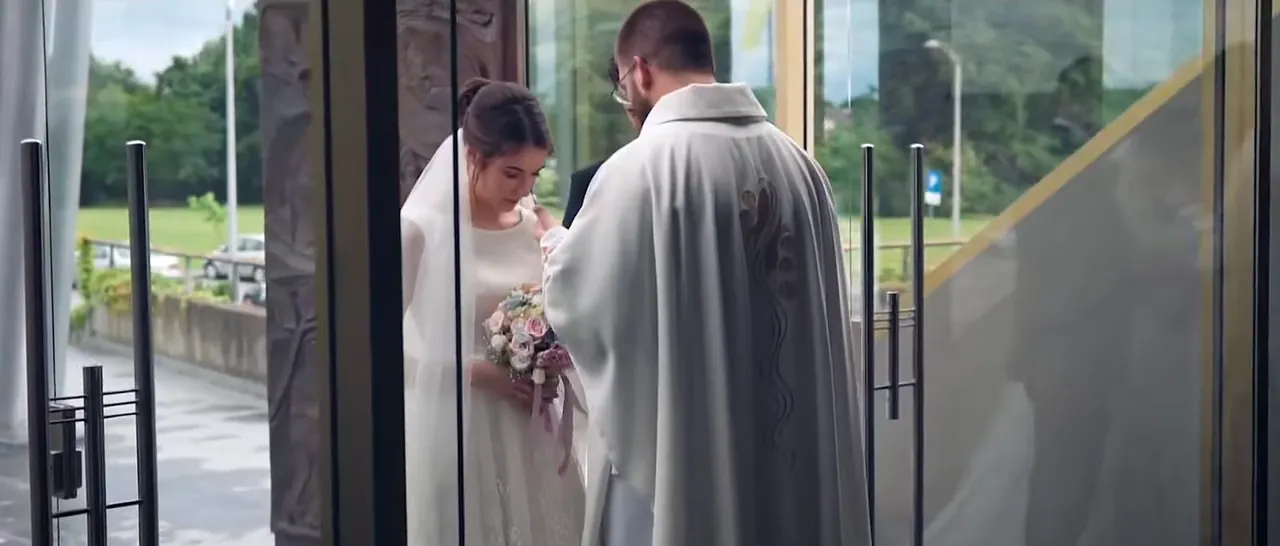
The ceremony is held in church or, for a civil wedding, in front of a registrar. Right after it comes a custom that surprises many foreign guests: every guest congratulates the couple in person, one after another. At a big wedding this takes a while, and it's a good moment for close shots of family and friends. During the ceremony itself the camera stays calm and discreet, so the ceremony stays a ceremony.
Music, the kolo and the night
Live music is at the heart of the celebration, from a tamburica band to a full band, and at some point the guests join hands in the kolo, a traditional circle dance. The party usually goes late into the night, and around midnight comes the cake, often together with the bouquet toss.
You can see a lot of this in Diana and Filip's wedding film: a tamburica band in the courtyard, wedding guests with flags and torches, and dancing on the grass late into the night.
Planning a Croatian wedding?
Send your date, venue and the customs your families keep. I'll suggest how to plan the filming so nothing important is missed.
Send an enquirystudio@velvetvision.artWhat this means for your wedding film
A Croatian wedding day is long, and the moments that matter most are spread from morning to midnight: picking up the bride, the ceremony, the congratulations, the first dance and the cake. If you want all of that in the film, plan for a full day - 12 hours covers the whole story. I cover how to work out the hours in the guide how many hours of coverage a wedding videographer needs.
Tell me which customs your families keep. Every region and every family does things a little differently, and knowing in advance helps me be in the right place when they happen. If you're getting married in Zagreb as a foreigner, the paperwork is covered in the guide on getting married in Zagreb as a foreigner on Piccolo Wedding.
Questions about Croatian wedding traditions
What is a barjak at a Croatian wedding?
The barjak is a traditional wedding flag, usually the Croatian flag decorated with ribbons. The barjaktar carries it at the head of the wedding party, from the house to the church and on to the celebration.
What does the kum do at a Croatian wedding?
The kum and kuma are the witnesses at the ceremony. They stand by the couple all day, help with the organisation and often give a toast.
How long does a Croatian wedding last?
Usually the whole day: from picking up the bride to the cake around midnight and the party after it. For a film of the whole day, plan for about 12 hours of coverage.

Damir Pišćetek
Wedding videographer and founder of Velvet Vision. I've been filming weddings since 2013 and have more than 300 behind me. For years I worked on large all-day weddings as part of a team, photo and video, and today, as Velvet Vision, I film and edit every wedding film myself. I'm a licensed drone pilot, so I fly the aerial shots personally too.
See also wedding films and the collections.


